シカゴスタイル(第17版)の参考文献を作成できます。書籍、学術誌、ウェブサイトの文献情報を入力すると、書式に合わせて自動作成。あとはコピー&ペーストするだけで利用できます。広告もありません。
引用(citation)とは、学術研究で使用した資料の出典を示すことです。参考文献一覧や脚注、本文中の出典表記は、研究の背景を裏付け、研究テーマに関連する追加資料を読者に示す役割を果たします。
シカゴ・マニュアル・オブ・スタイル(Chicago Manual of Style、CMOS)は、主に芸術、人文学、社会科学の分野で使われます。引用には、注・参考文献方式(Notes-Bibliography、NB方式)と著者・年方式(Author-Date方式)があります。NB方式は芸術・人文学で広く使われ、著者・年方式は社会科学でよく使われます。
注・参考文献方式(NB方式)と著者・年方式(Author-Date方式)は、形式だけでなく、読者への出典の示し方も異なります。このガイドでは、NB方式を中心に説明します。
この引用ガイドでは、シカゴスタイル第17版の主なルールを紹介します。Wordviceでは、MLA第7版・第8版、APA第6版・第7版、バンクーバースタイルの無料ガイドも提供しています。
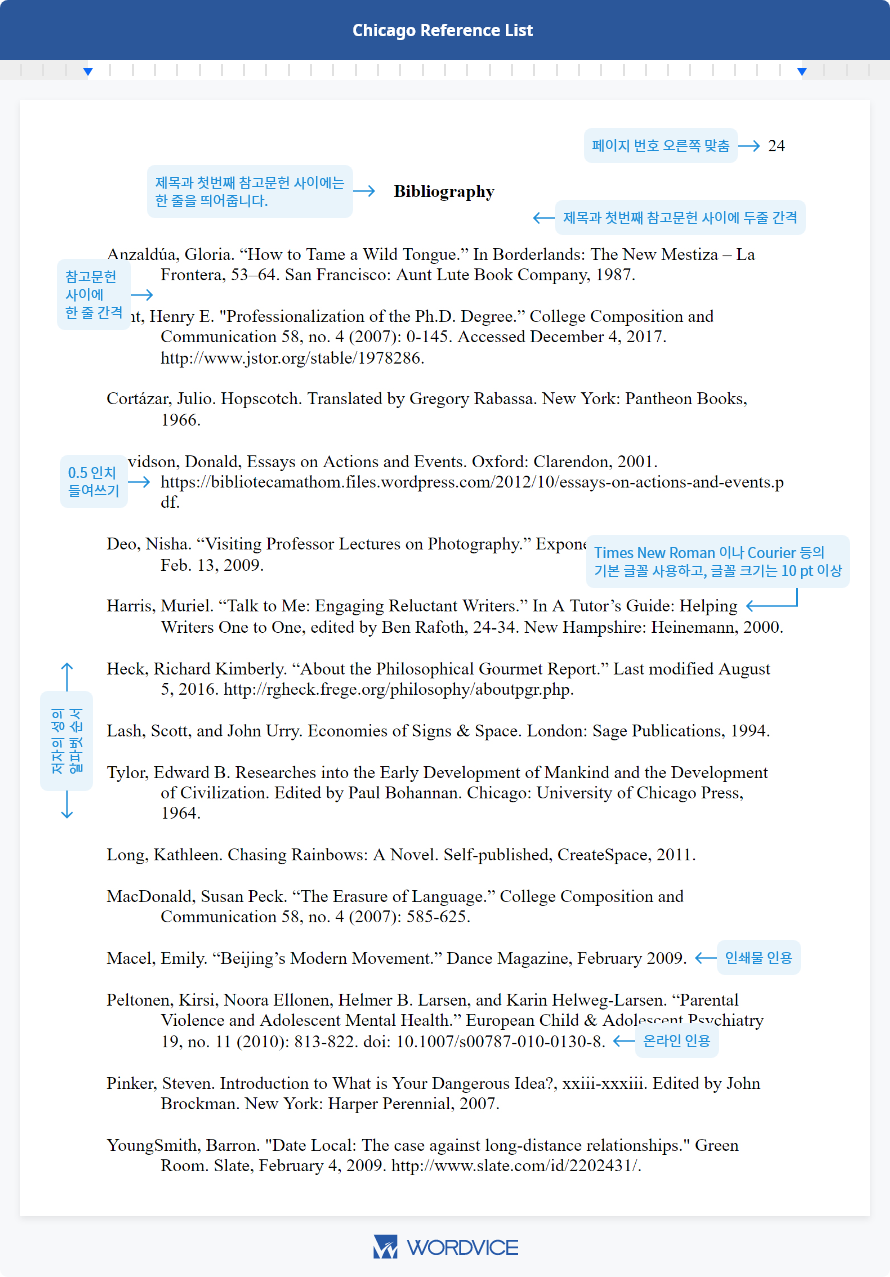
参考文献一覧(Bibliography)は、各項目の最初の単語を基準にアルファベット順に並べた出典の一覧です。CMOSの参考文献一覧は、MLAやAPAなど、一般的な他のスタイルガイドの参考文献一覧とは形式が異なります。脚注や後注に完全な書誌情報を記載している場合、参考文献一覧は必須ではありませんが、出典を確認しやすくするため、作成が推奨されることが多くあります。
Bibliography
Diamond, Jared. Guns, Germs, and Steel: The Fates of Human Societies. New York City: W.W. Norton, 1997.
Ishiguro, Kazuo. Never Let Me Go. London: Faber & Faber, 2005.
Rand, Ayn. The Art of Fiction: A Guide for Writers and Readers, New York City: Plume, 2000.
参考文献一覧の最初のページには、見出しとして"Bibliography"と記載します。見出しと最初の項目の間は2行空け、各項目の間は1行ずつ空けます。
シカゴスタイルの参考文献一覧に必要な書誌情報*:
*書誌情報の各要素はピリオドで区切ります。
脚注・後注:
1. [著者の名] [著者の姓], “[ウェブページのタイトル],” [ウェブサイト名], [発行者名], [公開日と更新日(不明な場合は閲覧日)], [URL].
1. Andrew Kim, “The History and Big Business of Academic Publishing,” Medium, August 26, 2020, https://medium.com/wordviceediting/the-history-and-big-business-of-academic-publishing-90a23bb7cc4c.
参考文献一覧の項目:
[著者の姓], [著者の名]. “[ウェブページのタイトル].” [ウェブサイト名]. [発行者名], [公開日と更新日(不明な場合は閲覧日)]. [URL].
Kim, Andrew. “The History and Big Business of Academic Publishing.” Medium. August 26, 2020. https://medium.com/wordviceediting/the-history-and-big-business-of-academic-publishing-90a23bb7cc4c.
脚注・後注:
1. [著者の名] [著者の姓], “[論文タイトル],” [学術誌名] [巻], no. [号] ([出版年]): [引用ページ].
1. Estíbaliz Encarnación-Pinedo, “On Webbed Monsters, Revolutionary Activists and Plutonium Glow: Eco-Crisis in Diane di Prima and Anne Waldman,” Humanities 10, no. 4 (2020): 1.
参考文献一覧の項目:
[著者の姓], [著者の名]. “[論文タイトル].” [学術誌名] [巻], no. [号] ([出版年]): [論文の掲載ページ範囲].
Encarnación-Pinedo, Estíbaliz. “On Webbed Monsters, Revolutionary Activists and Plutonium Glow: Eco-Crisis in Diane di Prima and Anne Waldman.” Humanities 10, no. 4 (2020): 1-14.
脚注・後注:
1. [著者の名] [著者の姓], “[論文タイトル],” [学術誌名] [巻], no. [号] ([出版年]): [引用ページ], accessed [閲覧日], [URL/DOI].
1. Estíbaliz Encarnación-Pinedo, “On Webbed Monsters, Revolutionary Activists and Plutonium Glow: Eco-Crisis in Diane di Prima and Anne Waldman,” Humanities 10, no. 4 (2020): 1. accessed January 25, 2021, https://doi.org/10.3390/h10010004.
参考文献一覧の項目:
[著者の姓], [著者の名]. “[タイトル].” [学術誌名] [巻], no. [号] ([出版年]): [論文の掲載ページ範囲]. Accessed [閲覧日]. [URL/DOI].
Encarnación-Pinedo, Estíbaliz. “On Webbed Monsters, Revolutionary Activists and Plutonium Glow: Eco-Crisis in Diane di Prima and Anne Waldman.” Humanities 10, no. 4 (2020): 1-14. Accessed January 25, 2021, https://doi.org/10.3390/h10010004.
脚注・後注:
1. [著者の名] [著者の姓], [タイトル] ([出版地]: [出版社], [出版年]), [ページ番号].
1. Jared Diamond, Guns, Germs, and Steel: The Fates of Human Societies (New York City: W.W. Norton, 1997), 25.
参考文献一覧の項目:
[著者の姓], [著者の名]. [タイトル]. [出版地]: [出版社], [出版年].
Diamond, Jared. Guns, Germs, and Steel: The Fates of Human Societies. New York City: W.W. Norton, 1997.
CMOSでは、引用する節や文の末尾に上付きの数字を付けます。この数字を「注番号(note numbers)」と呼び、ダッシュ以外の句読点の後に置きます。注番号は「1」から始め、文書全体、または書籍の場合は章ごとに通し番号を付けます。各番号は対応する脚注を示し、参考文献一覧がある場合は、その項目にも対応します。
本文中の引用例
As Jared Diamond writes in Guns, Germs, and Steel, “History followed different courses for different peoples because of differences among peoples' environments, not because of biological differences among peoples themselves.”¹
CMOSの注・参考文献方式(NB方式)では、直接引用や要約など、本文での使用方法にかかわらず、使用したすべての資料に注を付けます。注には脚注と後注があります。脚注は引用箇所と同じページの下部に、後注は章や文書の末尾に記載します。注が2行以上になる場合は、1行目を字下げします。
脚注・後注の例
1. Daisy Pixton and Lau Ming, Seeing Fishes from the Bottom: the Life and Times of Jacques Cousteau, (Chicago: University of Chicago Press, 2002), 98-101.
参考文献一覧を付ける場合、脚注や後注に出典の出版情報をすべて記載する必要はなく、短縮形を使用できます。短縮形には通常、著者の姓と、4語以内に短縮した引用元のタイトルを記載します。
1. Jared Diamond, Guns, Germs, and Steel: The Fates of Human Societies (New York City: W.W. Norton, 1997), 25.
1. Diamond, Guns, Germs, and Steel, 25.
シカゴスタイル第17版では、いくつかの改訂が行われました。ここでは、引用に関する主な変更点を2つ紹介します。
ウェブサイト名は、印刷版がある場合にのみイタリック体にします。印刷版がない場合は、イタリック体にしません。
改訂前:
1. Andrew Kim, “The History and Big Business of Academic Publishing,” Medium, August 26, 2020, https://medium.com/wordviceediting/the-history-and-big-business-of-academic-publishing-90a23bb7cc4c.
改訂後:
1. Andrew Kim, “The History and Big Business of Academic Publishing,” Medium, August 26, 2020, https://medium.com/wordviceediting/the-history-and-big-business-of-academic-publishing-90a23bb7cc4c.
「ibid.」の使用は推奨されなくなりました。代わりに、脚注の短縮形を使用します。
改訂前:初出の脚注には完全な書誌情報を記載し、以降はibid.を使用します。
1. Jared Diamond, Guns, Germs, and Steel: The Fates of Human Societies (New York City: W.W. Norton, 1997), 25.
2. Ibid.
3. Ibid., 90.
改訂後:初出の脚注には完全な書誌情報を記載し、以降は短縮形を使用します。
1. Jared Diamond, Guns, Germs, and Steel: The Fates of Human Societies (New York City: W.W. Norton, 1997), 25.
2. Diamond, Guns, Germs, and Steel, 25.
3. Diamond, Guns, Germs, and Steel, 90.
