Chicago Style (or Chicago Manual of Style) is primarily used for academic papers in the arts, humanities, and social sciences. Our free Chicago Style Citation Generator automatically generates references and citations for Chicago 17th–the most recent Chicago Style edition. Read the Chicago Style citation guidelines at the bottom of the page for specific Chicago in-text citation and reference rules.
Citations are references to sources that you have used in your academic study. Including references and in-text citations in your work performs some crucial functions, such as validating the background of your research and providing researchers additional sources to explore that are related to your study topic.
The Chicago Manual of Style (CMOS) is used primarily for works in the arts, humanities, and social sciences. There are two variations of CMOS citations: Notes-Bibliography (NB) and Author-Date. The NB style is widely used in the arts and humanities, while Author-Date is more common in the social sciences.
These two systems differ in formatting as well as in how they direct readers to the sources. This quick guide is focused on the NB system.
This citation guide introduces important aspects and guidelines from the Chicago Manual of Style 17th Edition. Wordvice also offers free guides for MLA 7 and 8, APA 6 and 7, and Vancouver styles.
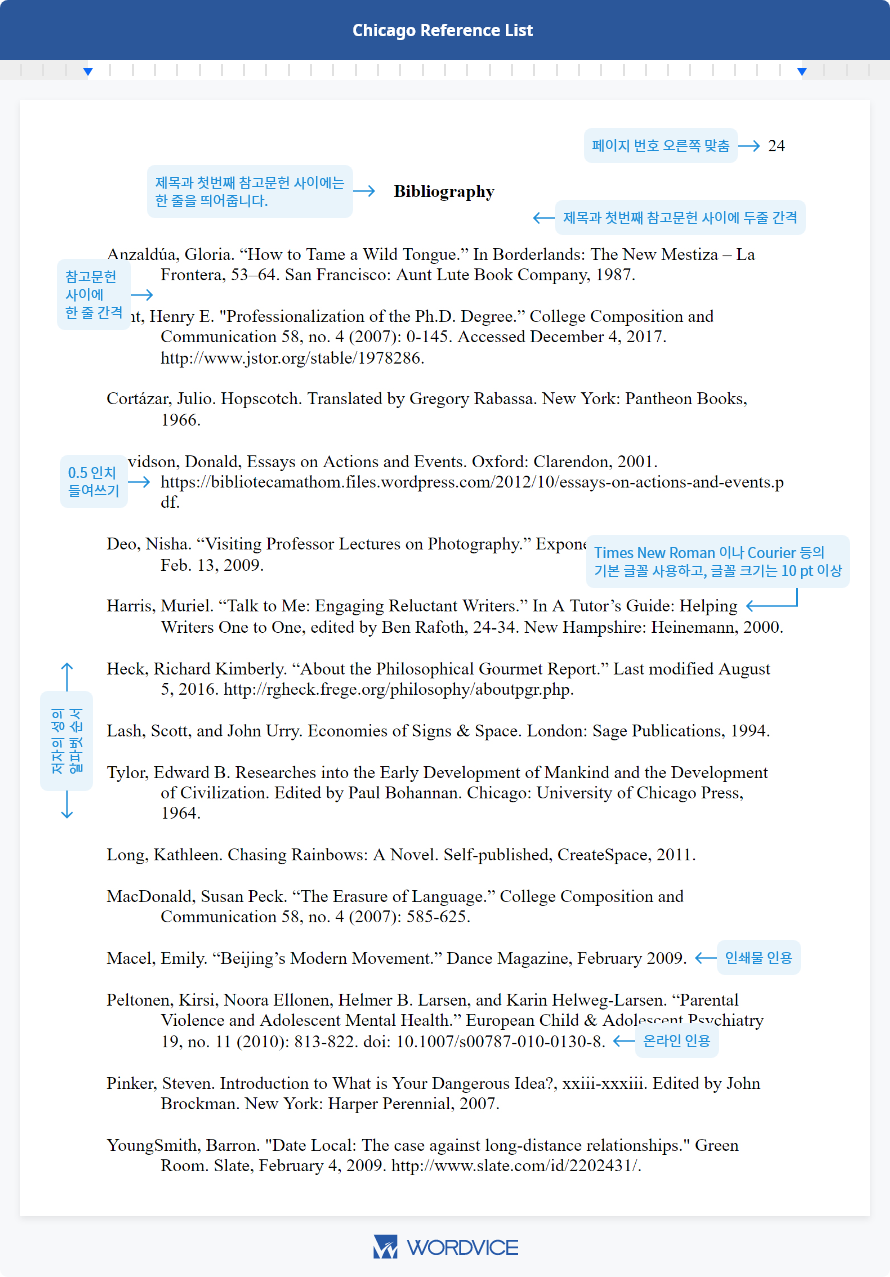
A bibliography is a complete list of sources arranged in alphabetical order according to the first word of each entry. A CMOS bibliography differs from the reference pages of other commonly used style guides such as MLA and APA, for example, in that it is not strictly required. If complete bibliographic information is present in the notes, including a separate bibliography is unnecessary but still often recommended to make your sources easier to view and search.
Bibliography
Diamond, Jared. Guns, Germs, and Steel: The Fates of Human Societies. New York City: W.W. Norton, 1997.
Ishiguro, Kazuo. Never Let Me Go. London: Faber & Faber, 2005.
Rand, Ayn. The Art of Fiction: A Guide for Writers and Readers, New York City: Plume, 2000.
The first page of the bibliography should be titled “Bibliography.” Include two blank lines between the title and first entry and one blank line between each of the remaining entries.
Elements of a CMOS bibliography*:
*All major elements are separated by periods.
Footnote or Endnote:
1. [Author First Name] [Author Last Name], “[Page Title],” [Website Name], [Name of Publisher], [publication or revision date if available, access date if unavailable], [URL].
1. Andrew Kim, “The History and Big Business of Academic Publishing,” Medium, August 26, 2020, https://medium.com/wordviceediting/the-history-and-big-business-of-academic-publishing-90a23bb7cc4c.
Bibliographic Entry:
[Author Last Name], [Author First Name]. “[Page Title].” [Website Name]. [Name of Publisher], [publication or revision date if available, access date if unavailable]. [URL].
Kim, Andrew. “The History and Big Business of Academic Publishing.” Medium. August 26, 2020. https://medium.com/wordviceediting/the-history-and-big-business-of-academic-publishing-90a23bb7cc4c.
Footnote or Endnote:
1. [Author First Name] [Author Last Name], “[Article Title],” [Journal Name] [Volume], no. [Issue] ([Year Published]): [Cited Page].
1. Estíbaliz Encarnación-Pinedo, “On Webbed Monsters, Revolutionary Activists and Plutonium Glow: Eco-Crisis in Diane di Prima and Anne Waldman,” Humanities 10, no. 4 (2020): 1.
Bibliographic Entry:
[Author Last Name], [Author First Name]. “[Article Title].” [Journal Name] [Volume], no. [Issue] ([Year Published]): [Entire Page Range of Article].
Encarnación-Pinedo, Estíbaliz. “On Webbed Monsters, Revolutionary Activists and Plutonium Glow: Eco-Crisis in Diane di Prima and Anne Waldman.” Humanities 10, no. 4 (2020): 1-14.
Footnote or Endnote:
1. [Author First Name] [Author Last Name], “[Article Title],” [Journal Name] [Volume], no. [Issue] ([Year Published]): [Cited Page], accessed [Accessed Date], [URL/DOI].
1. Estíbaliz Encarnación-Pinedo, “On Webbed Monsters, Revolutionary Activists and Plutonium Glow: Eco-Crisis in Diane di Prima and Anne Waldman,” Humanities 10, no. 4 (2020): 1. accessed January 25, 2021, https://doi.org/10.3390/h10010004.
Bibliographic Entry:
[Author Last Name], [Author First Name]. "[Article Title].” [Journal Name] [Volume], no. [Issue] ([Year Published]): [Entire Page Range of Article]. Accessed [Accessed Date]. [URL/DOI].
Encarnación-Pinedo, Estíbaliz. “On Webbed Monsters, Revolutionary Activists and Plutonium Glow: Eco-Crisis in Diane di Prima and Anne Waldman.” Humanities 10, no. 4 (2020): 1-14. Accessed January 25, 2021, https://doi.org/10.3390/h10010004.
Footnote or Endnote:
1. [Author First Name] [Author Last Name], [Book Title] ([Publication Location]: [Publisher Name], [Year Published]), [Page Number].
1. Jared Diamond, Guns, Germs, and Steel: The Fates of Human Societies (New York City: W.W. Norton, 1997), 25.
Bibliographic Entry:
[Author Last Name], [Author First Name]. [Book Title]. [Publication Location]: [Publisher Name], [Year Published].
Diamond, Jared. Guns, Germs, and Steel: The Fates of Human Societies. New York City: W.W. Norton, 1997.
CMOS in-text citations use superscripts placed at the end of the clause or sentence to which they refer. These numbers are called “note numbers” and are placed after all punctuation marks except dashes. The first note number listed is “1,” and the rest should follow consecutively throughout a given work or chapter (in the case of books). Each number refers to a footnote and its corresponding bibliographic entry, when applicable.
In-text Citation Example
As Jared Diamond writes in Guns, Germs, and Steel, “History followed different courses for different peoples because of differences among peoples' environments, not because of biological differences among peoples themselves.”¹
CMOS NB requires a note for every source used, regardless of how it is applied in the text (direct quote, summary, etc.). A note may be in the form of a footnote or endnote. A footnote is located at the bottom of the page on which the corresponding source is referenced; an endnote is located at the end of a chapter or document. When these notes are two or more lines in length, the first line is indented.
Footnote/Endnote Example
1. Daisy Pixton and Lau Ming, Seeing Fishes from the Bottom: the Life and Times of Jacques Cousteau, (Chicago: University of Chicago Press, 2002), 98-101.
If a bibliography is included, full publication details are not necessary to provide in the notes. In such cases, notes can be “shortened.” A shortened note usually comprises the authors’ last names and the source title condensed into four or fewer keywords.
1. Jared Diamond, Guns, Germs, and Steel: The Fates of Human Societies (New York City: W.W. Norton, 1997), 25.
1. Diamond, Guns, Germs, and Steel, 25.
There have been several updates made in Chicago 17th. The following are two key changes made in relation to citations.
Website titles should only be italicized if the website has a print counterpart. Otherwise, it should not be italicized.
Previously:
1. Andrew Kim, “The History and Big Business of Academic Publishing,” Medium, August 26, 2020, https://medium.com/wordviceediting/the-history-and-big-business-of-academic-publishing-90a23bb7cc4c.
Currently:
1. Andrew Kim, “The History and Big Business of Academic Publishing,” Medium, August 26, 2020, https://medium.com/wordviceediting/the-history-and-big-business-of-academic-publishing-90a23bb7cc4c.
The use “ibid.” is now discouraged. Instead of “ibid.,” a shortened footnote should be included.
Previously: Provide full footnotes followed by the use of Ibid.
1. Jared Diamond, Guns, Germs, and Steel: The Fates of Human Societies (New York City: W.W. Norton, 1997), 25.
2. Ibid.
3. Ibid., 90.
Currently: Provide full footnotes followed by shortened footnotes.
1. Jared Diamond, Guns, Germs, and Steel: The Fates of Human Societies (New York City: W.W. Norton, 1997), 25.
2. Diamond, Guns, Germs, and Steel, 25.
3. Diamond, Guns, Germs, and Steel, 90.
