APA Style is commonly used by researchers and students in the social sciences, behavioral sciences, business, and nursing. Our free APA citation generator automatically generates references and in-text citations for APA 6 and APA 7 styles. Read the APA citation guidelines at the bottom of the page for specific APA in-text citation and reference rules.
Citations are references to sources that you have used in your academic study. Including references and in-text citations in your work performs some crucial functions, such as validating the background of your research and providing researchers additional sources to explore related to your study topic.
APA (American Psychological Association) style is commonly used by writers and students in the social sciences, behavioral sciences, business, and nursing.
This citation guide introduces important aspects and guidelines from the 7th edition APA Publication Manual (2020). Wordvice also offers free guides for the older APA 6th, MLA 7 and 8, Chicago 17th, and Vancouver style guides.
APA references usually include information about the author, publication date, and title of a source. Depending on the type of source, references are subject to special rules and may require additional information about the source material.
Even with detailed guidelines, citing sources can be challenging. Please view examples provided on the Wordvice Citation Generator to learn more about each source type format.
Sometimes the required citation information is unknown or missing, especially with sources found online. Refer to the table below on how to cite unknown sources.
| Missing Element | Solution | Reference Format |
|---|---|---|
| Author | Begin the reference entry with the source title. | Title. (Date). Source. |
| Date | Write “n.d.” for “no date”. | Author. (n.d.). Title. Source. |
| Title | Describe the cited work using square brackets. | Author. (Date). [Description]. Source. |
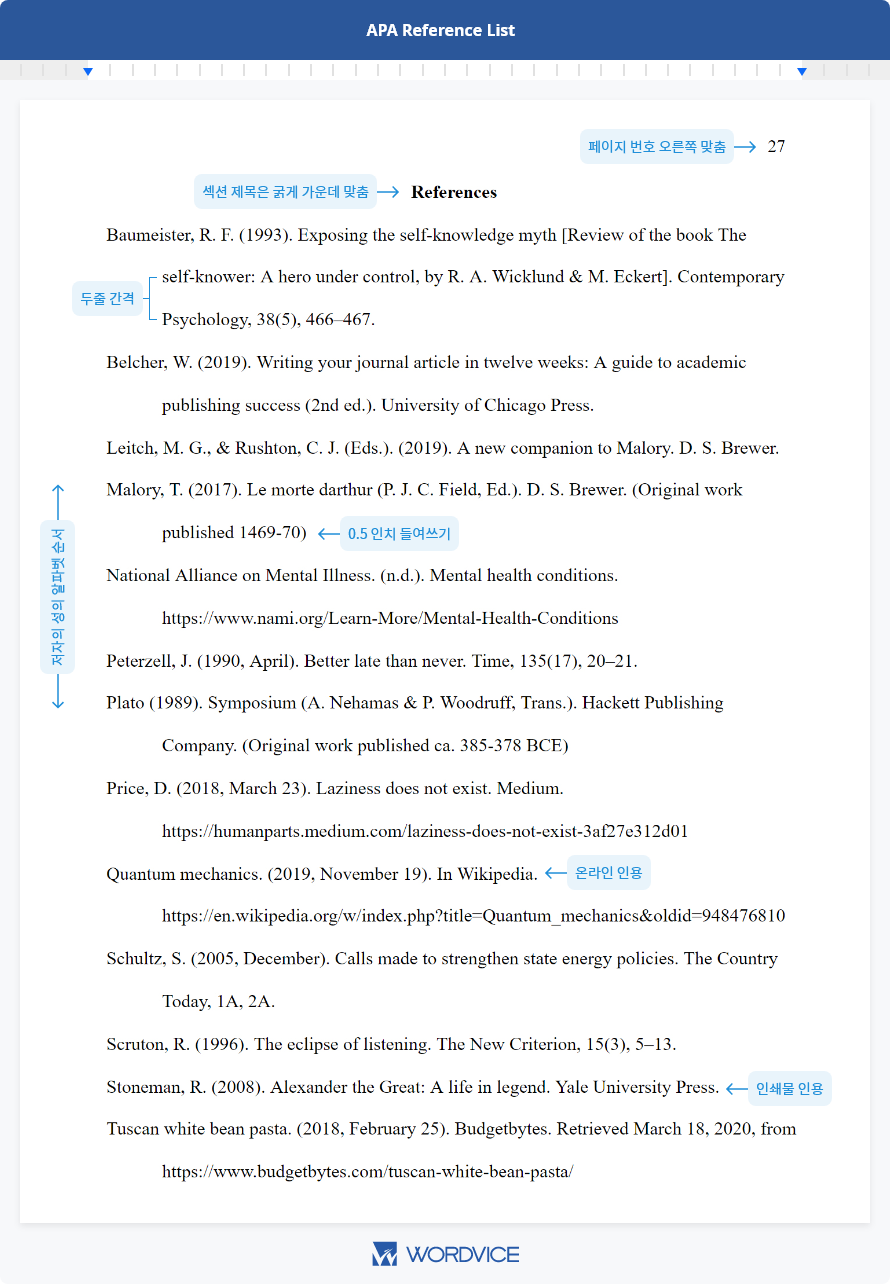
The reference list provides the information of all the sources that you've cited throughout your paper. In the reference list, only include sources that you have cited in the text.
Follow these formatting guidelines for the APA reference page:
In-text citations are brief references in your text that identify the source presented in the reference list. If you quote or paraphrase someone else's work, you must include in-text citations.
The APA in-text citation format follows the author-date method, consisting of the author's last name and publication year. If you are directly citing or borrowing from a source, you should include a page number using the abbreviation "p/pp." When citing a specific portion of a source, include identifying information such as a timestamp or page. For example: (Harken, 2018, pp. 145-153).
The in-text citation can either be in parenthetical or narrative form. A parenthetical citation should follow the content you are citing from a given source. For example:
In 2010, everything we once knew ... (Kim, 2008).
A narrative citation emphasizes the author of the source you are using. For example:
Kim (2008) notes that …
| Type | Parenthetical Citation | Narrative Citation |
|---|---|---|
| One author | (Kim, 2020) | Kim (2020) |
| Two authors | (Tshitoyan & Dagdelen, 2019) | Tshitoyan and Dagdelen (2019) |
| Three or more authors | (Tshitoyan et al., 2020) | Tshitoyan et al. (2020) |
| Organization | (Wordvice, 2020) | Wordvice (2020) |
When any information needed to create the in-text citation is unknown, refer to the table below.
| Unknown Element | Solution | In-text Citation |
|---|---|---|
| Author | Provide the source title.* | (Source Title, year) |
| Date | Write “n.d.” for “no date”. | (Author, n.d.) |
| Title | Provide the author and date. | (Author, year) or Author (year) |
* Source title should follow the general title capitalization rules and title format depending on the source type. Also, if the title in the reference entry is not italicized, place in quotation marks.
The APA was updated to 7th Edition in the fall of 2019. This resource presents a list of key differences between the 6th and 7th editions.
The 7th Edition of the APA Publication Manual contains various updates. Below are some of the key changes made to the references page and in-text citation guidelines.
