MLA Style is commonly used by authors and students preparing manuscripts and research papers for humanities disciplines such as cultural studies, English, literature, and critical theory. Our free MLA Citation Generator automatically generates references and citations for MLA 7 and MLA 8 styles. Read the MLA citation guidelines at the bottom of the page for specific MLA in-text citation and reference rules.
Citations are references to sources that you have used in your academic study. Including references and in-text citations in your work performs some crucial functions, such as validating the background of your research and providing researchers additional sources to explore that are related to your study topic.
MLA (Modern Language Association) style is commonly used by writers and students preparing manuscripts in disciplines in the humanities, such as cultural studies, English, literature, and critical theory.
This citation guide introduces important aspects and guidelines from the 8th edition of the MLA Style manual. Wordvice also offers free style guides for MLA 7, APA 6 and 7, Chicago 17th, and Vancouver styles.
According to MLA guidelines, citations should include elements with the corresponding punctuation marks and should be listed in the following order:
When citing a source in the Reference page, present the nine elements listed above using this format:
Author. "Title of Source." Title of Publication, Other contributors, Version, Number, Publisher, Publication date, Location.
Only include information relevant to the type of source you’re citing and include all elements that you can locate for a given source.
Sometimes the core elements like the author, the source title, and the publication date are unknown or missing. In such cases, refer to the table below.
| Unknown Element | Solution | Reference Format |
|---|---|---|
| Author | Start the reference with the source title in quotations. | “How to Teach Yourself Guitar.” eHow, Demand Media, www.ehow.com/how_5298173_teach-yourself-guitar.html. Accessed 13 November 2020. |
| Date | Add the accessed date at the end of the citation. | “Wordvice Professional Editors & Proofreaders.” Wordvice, https://wordvice.com/about-us/editors/. Accessed 25 July 2019. |
| Title | Describe the source without using italics or quotation marks. | Brennan, Marie. Irish illuminated manuscript. 1350-1380, National Museum of Ireland, Dublin. |
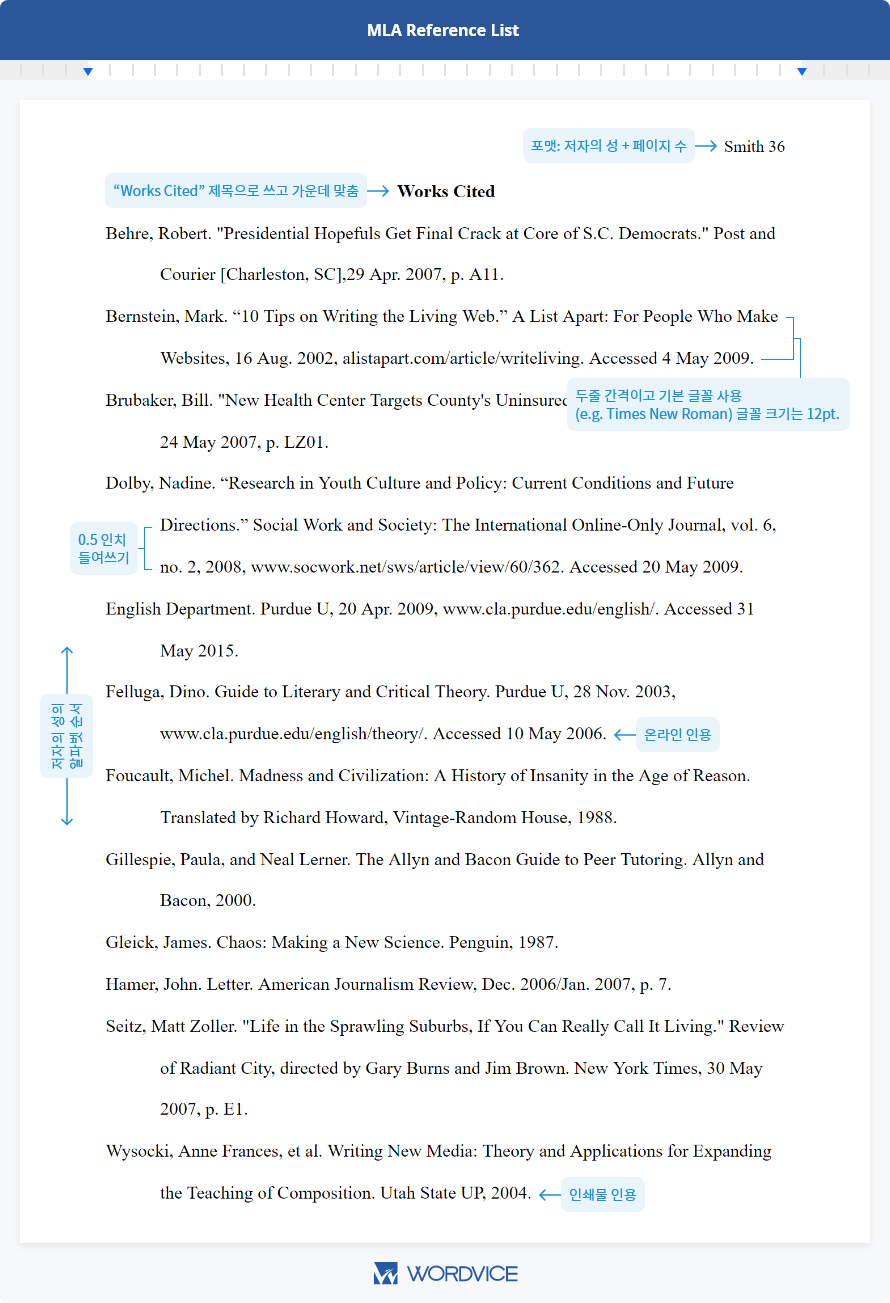
The reference page provides the information of all the sources that you've cited throughout your paper. In the reference list, only include sources that you have cited in the text.
Follow these formatting guidelines for the MLA reference page:
In-text citations are brief references within your text to the source(s) listed in your reference list. If you quote or paraphrase someone else's work, you must include in-text citations.
The MLA in-text citation format follows the author-page method, consisting of the author's last name and page number(s). The author's name may appear in the text of your sentence, but the page number(s) should always appear in the parentheses.
| Author | Solution | Example |
|---|---|---|
| One author | Include the author’s last name. | (Desmond 13–15) |
| Two authors | Include the last names of both authors. | (Desmond and Theigg 13-15) |
| Three or more authors | Name the first author followed by “et al.” | (Desmond et al. 13-15) |
| Organization | Use the organization name as author. | (U.N. Refugee Program 33) |
The MLA was updated to 8th Edition in April 2016. This resource presents a list of the key differences between the 7th and 8th editions.
