Written by Wordvice715,109Updated Jun 9, 20259 min read
The academic community can be conservative when it comes to enforcing academic writing style, but your writing shouldn’t be so boring that people lose interest midway through the first paragraph! Given that competition is at an all-time high for academics looking to publish their papers, we know you must be anxious about what you can do to improve your publishing odds.
To be sure, your research must be sound, your paper must be structured logically, and the different manuscript sections must contain the appropriate information. But your research must also be clearly explained. Clarity obviously depends on the correct use of English, and there are many common mistakes that you should watch out for, for example when it comes to articles, prepositions, word choice, and even punctuation. But even if you are on top of your grammar and sentence structure, you can still make your writing more compelling (or more boring) by using powerful verbs and phrases (vs the same weaker ones over and over). So, how do you go about achieving the latter?
Below are a few ways to breathe life into your writing.
Have you heard of “Wordles”? A Wordle is a visual representation of words, with the size of each word being proportional to the number of times it appears in the text it is based on. The original company website seems to have gone out of business, but there are a number of free word cloud generation sites that allow you to copy and paste your draft manuscript into a text box to quickly discover how repetitive your writing is and which verbs you might want to replace to improve your manuscript.
Seeing a visual word cloud of your work might also help you assess the key themes and points readers will glean from your paper. If the Wordle result displays words you hadn’t intended to emphasize, then that’s a sign you should revise your paper to make sure readers will focus on the right information.
As an example, below is a Wordle of our article entitled, “How to Choose the Best title for Your Journal Manuscript.” You can see how frequently certain terms appear in that post, based on the font size of the text. The keywords, “titles,” “journal,” “research,” and “papers,” were all the intended focus of our blog post.
2. Study Language Patterns of Similarly Published Works
Study the language pattern found in the most downloaded and cited articles published by your target journal. Understanding the journal’s editorial preferences will help you write in a style that appeals to the publication’s readership.
Another way to analyze the language of a target journal’s papers is to use Wordle (see above). If you copy and paste the text of an article related to your research topic into the applet, you can discover the common phrases and terms the paper’s authors used.
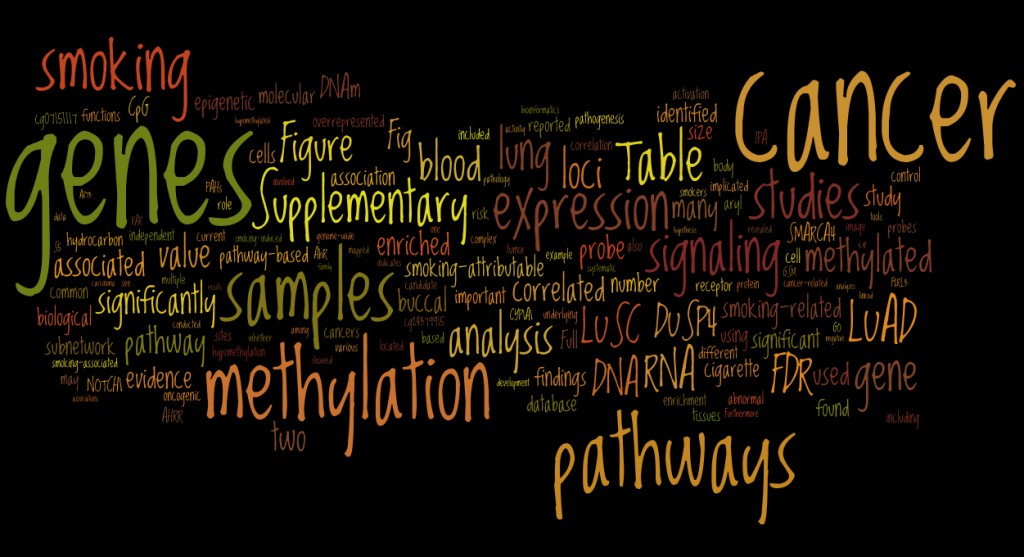
For example, if you were writing a paper on links between smoking and cancer, you might look for a recent review on the topic, preferably published by your target journal. Copy and paste the text into Wordle and examine the key phrases to see if you’ve included similar wording in your own draft. The Wordle result might look like the following, based on the example linked above.
If you are not sure yet where to publish and just want some generally good examples of descriptive verbs, analytical verbs, and reporting verbs that are commonly used in academic writing, then have a look at this list of useful phrases for research papers.
3. Use More Active and Precise Verbs
Have you heard of synonyms? Of course you have. But have you looked beyond single-word replacements and rephrased entire clauses with stronger, more vivid ones? You’ll find this task is easier to do if you use the active voice more often than the passive voice. Even if you keep your original sentence structure, you can eliminate weak verbs like “be” from your draft and choose more vivid and precise action verbs. As always, however, be careful about using only a thesaurus to identify synonyms. Make sure the substitutes fit the context in which you need a more interesting or “perfect” word. Online dictionaries such as the Merriam-Webster and the Cambridge Dictionary are good sources to check entire phrases in context in case you are unsure whether a synonym is a good match for a word you want to replace. (You can also use a rephraser to get inspiration for rewrites and synonym choices.)
To help you build a strong arsenal of commonly used phrases in academic papers, we’ve compiled a list of synonyms you might want to consider when drafting or editing your research paper. While we do not suggest that the phrases in the “Original Word/Phrase” column should be completely avoided, we do recommend interspersing these with the more dynamic terms found under “Recommended Substitutes.”
A. Describing the scope of a current project or prior research
Purpose
Original Word/Phrase
Recommended Substitute
To express the purpose of a paper or research
This paper/ study/ investigation…
aims to
This paper + [use the verb that originally followed “aims to”] or This paper + (any other verb listed above as a substitute for “explain”) + who/what/when/where/how X. For example:
“This paper applies X to Y,” instead of, “This paper aims to apply X to Y.”
“This paper explores how lower sun exposure impacts moods,” instead of, “This paper aims to address the impact of lower sun exposure on moods.”
To introduce the topic of a project or paper
The paper/ study/ article/ work…
Prior research/ investigations…
discusses
presents
surveys
questions
highlights
outlines
features
investigates
To describe the analytical scope of a paper or study
The paper/ study/ article/ work…
Prior research/ investigations…
considers
analyzes
explains
evaluates
interprets
clarifies
identifies
delves into
advances
appraises
defines
dissects
probes
tests
explores
*Adjectives to describe degree can include: briefly, thoroughly, adequately, sufficiently, inadequately, insufficiently, only partially, partially, etc.
To preview other sections of a paper
Section X…
covers
deals with
talks about
outlines
highlights
sketches
assesses
contemplates
[any of the verbs suggested as replacements for “explain,” “analyze,” and “consider” above]
B. Outlining a topic’s background
Purpose
Original Word/Phrase
Recommended Substitute
To discuss the historical significance of a topic
Subject/ Mechanism…
plays an important in [nominalization]
plays a vital role in [nominalization]
Topic significantly/considerably +
influences
controls
regulates
directs
inhibits
constrains
governs
+ who/what/when/where/how…
*In other words, take the nominalized verb and make it the main verb of the sentence.
To describe the historical popularity of a topic
X Theory…
…is widely accepted as…
…is widely used as…
Widely accepted, … [to eliminate the weak be verb]
The preferred…
Commonly/Frequently implemented,… [to eliminate the weak be verb]
The prevailing method for…
To describe the recent focus on a topic
Much attention has been drawn to
…has gained much importance in recent years
Discussions regarding X have dominated research in recent years.
…has appealed to…
…has propelled to the forefront in investigations of Y.
… has dramatically/significantly shaped queries on X in recent years.
…has critically influenced academic dialogue on Y.
To identify the current majority opinion about a topic
The consensus has been that…
Prior research generally confirms that…
Several studies agree that…
Prior research substantiates the belief that…
To discuss the findings of existing literature
Previous studies…
indicate
have documented
have demonstrated
have shown that
contend
purport
suggest
proffer
have proven that
evidence
To express the breadth of our current knowledge-base, including gaps
Much is known about…
But, little is known about…
The academic community has extensively explored X…
Prior research has thoroughly investigated….
However, little research has been conducted to show…
However, prior studies have failed to evaluate/ identify / (any other word suggested to replace “analyze” above)
To segue into expressing your research question
Several theories have been proposed to explain…
To solve this problem, many researchers have tried several methods
Recent/Previous studies have promoted…
Prior investigations have implemented/ queried diverse approaches to…
A number of authors have posited…
C. Describing the analytical elements of a paper
Purpose
Original Word/Phrase
Recommended Substitute
To express agreement between one finding and another
This paper/ study/ investigation
supports
substantiates
confirms
corroborates
underlines
To present contradictory findings
This paper/ study/ investigation
calls into question
challenges
disputes
rebuts
refutes
disproves
debunks
invalidates
rejects
questions
To discuss limitations of a study
The limitations of this paper include:
These investigations, however, disregards…
This method/ approach fails to…
This study only…
…falls short of addressing/ identifying / illustrating…
A drawback/disadvantage of this framework is…
This framework, however, solely pertains to…
D. Discussing results
Purpose
Original Word/Phrase
Recommended Substitute
To draw inferences from results
The data…
These findings…
suggest
show
extrapolate
deduce
surmise
approximate
derive
extract
evidence
To describe observations
[Observed event or result]…
appeared
was observed to
manifested
surfaced
materialized
yielded
generated
perceived
detected
E. Discussing methods
Purpose
Original Word/Phrase
Recommended Substitute
To discuss methods
This study…
X method…
used
performed
applied
administered
employed
diffused
disseminated
relayed
To describe simulations
A simulation…
was created to…
was used to…
was performed to…
This study/ research…
simulated
replicated
imitated
+
“X environment/ condition to..”
+
[any of the verbs suggested as replacements for “analyze” above]
F. Explaining the impact of new research
Purpose
Original Word/Phrase
Recommended Substitute
To explain the impact of a paper’s findings
This paper/ study/ investigation
demonstrates
shows
illustrates
proves
evidences
strengthens (the position that)
To highlight a paper’s conclusion
This paper/ study/ investigation
establishes
proves
attributes
illustrates
advances (the idea that)
To explain how research contributes to the existing knowledge-base
This paper/ study/ investigation
offers
introduces
ushers in
proffers
conveys
promotes
advocates
introduces
broach (issue)
reveals
unveils
exposes
unearths
Wordvice Writing Resources
For additional information on how to tighten your sentences (e.g., eliminate wordiness and use active voice to greater effect), you can try Wordvice’s FREE APA Citation Generator and learn more about how to proofread and edit your paper to ensure your work is free of errors.