
The Common Application has confirmed that all seven Common App essay prompts will remain unchanged for the 2026–2027 application cycle. Although the prompts may seem familiar, choosing the right topic and transforming it into a focused, personal narrative remains crucial for crafting a compelling Common App essay.
In this guide, we explore all seven Common App essay prompts for 2026–2027 and provide insights on selecting the prompt that aligns perfectly with your narrative. You’ll also find various topic ideas, example outlines, and helpful tips for structuring a 650-word essay. Additionally, you’ll receive practical advice for writing a clear, authentic personal statement that helps admissions officers understand you beyond just your grades and activities.
2026–2027 Common App Essay Prompts
Here are the seven official Common App essay prompts for the 2026–2027 application cycle:
- Some students have a background, identity, interest, or talent that is so meaningful they believe their application would be incomplete without it. If this sounds like you, then please share your story.
- The lessons we take from obstacles we encounter can be fundamental to later success. Recount a time when you faced a challenge, setback, or failure. How did it affect you, and what did you learn from the experience?
- Reflect on a time when you questioned or challenged a belief or idea. What prompted your thinking? What was the outcome?
- Reflect on something that someone has done for you that has made you happy or thankful in a surprising way. How has this gratitude affected or motivated you?
- Discuss an accomplishment, event, or realization that sparked a period of personal growth and a new understanding of yourself or others.
- Describe a topic, idea, or concept you find so engaging that it makes you lose all track of time. Why does it captivate you? What or who do you turn to when you want to learn more?
- Share an essay on any topic of your choice. It can be one you’ve already written, one that responds to a different prompt, or one of your own design.
Which Common App Essay Prompt Should You Choose?
There is no single “best” Common App essay prompt. Admissions officers typically focus on what your essay conveys about you rather than the specific prompt you choose.
Instead of selecting a prompt first and forcing a story around it, start with the experiences, relationships, interests, challenges, or ideas that have influenced you. Then choose the prompt that allows you to convey that narrative in the most authentic manner.
A strong Common App essay should reveal something meaningful about you that may not be immediately apparent from your grades, activities, or other sections of your application.
Here is a quick guide:
| If you want to write about… | Consider |
|---|---|
| Your background, identity, culture, interest, or talent | Prompt #1 |
| A challenge, setback, or failure and what you learned | Prompt #2 |
| A belief or idea you questioned or challenged | Prompt #3 |
| Gratitude and how it affected or motivated you | Prompt #4 |
| An accomplishment, event, or realization that contributed to personal growth | Prompt #5 |
| A topic or idea you are deeply curious about | Prompt #6 |
| A meaningful story that does not naturally fit the other prompts | Prompt #7 |
Which Common App prompt is most popular?
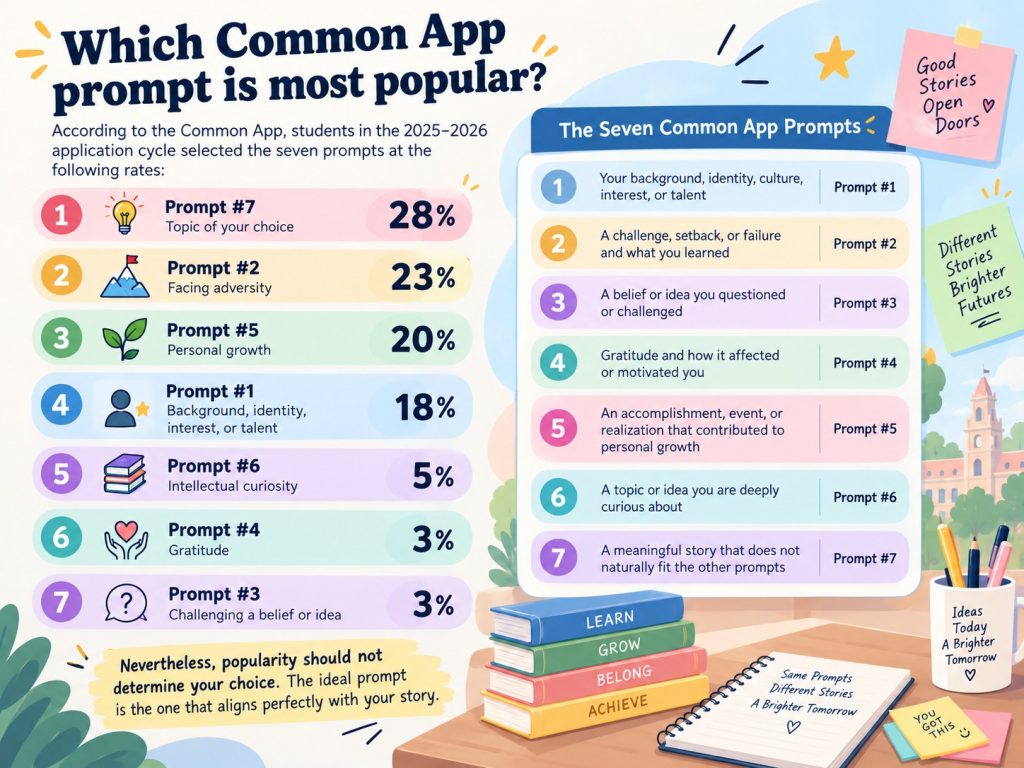
According to the Common App, students in the 2025–2026 application cycle selected the seven prompts at the following rates:
- Prompt #7, Topic of your choice: 28%
- Prompt #2, Facing adversity: 23%
- Prompt #5, Personal growth: 20%
- Prompt #1, Background, identity, interest, or talent: 18%
- Prompt #6, Intellectual curiosity: 5%
- Prompt #4, Gratitude: 3%
- Prompt #3, Challenging a belief or idea: 3%
Nevertheless, popularity should not determine your choice. The ideal prompt is the one that aligns perfectly with your story.
How To Write Common App Prompt #1: Background, Identity, Interest, or Talent
Prompt #1: Some students have a background, identity, interest, or talent that is so meaningful they believe their application would be incomplete without it. If this sounds like you, then please share your story.
Common App Prompt #1 is one of the most flexible Common App essay options. It is most effective when you possess a background, identity, interest, or talent that is crucial for expressing your true self, rather than just showcasing something impressive that appears elsewhere in your application.
What is this prompt asking?
What part of your identity or experience is essential to understanding your true self? The most impactful essays go beyond merely outlining a culture, hobby, family background, or talent. They show how that part of your life has shaped your thoughts, actions, relationships with others, and self-understanding.
Interesting topics for Prompt #1
- Embracing significant responsibilities in your family
- Growing up between languages, cultures, and communities
- A long-term interest that became part of how you perceive yourself
- A family tradition or experience that shaped your values
- An unusual role, responsibility, or skill that influenced your identity
- A distinctive interest, such as a love of old jazz or collecting art, that shaped your self-perception
Topics to avoid
- A résumé-style list of achievements or talents
- Broad descriptions of your culture without specific individual anecdotes
- A hobby essay detailing activities without discussing their significance
- Trying too hard to prove your uniqueness instead of showing it through details
Sample outline
Topic: Translating for family members
- Open with a specific moment when you had to translate an important conversation.
- Explain the process and reasons that led you to become the person your family depends on.
- Describe a challenging experience that reshaped your perspective on responsibility.
- Reflect on how the experience shaped your communication, empathy, or confidence.
- Conclude by illustrating how that role continues to shape your identity today.
A more unusual topic can work just as well. For example, a student fascinated by old jazz could explore memory, taste, and identity by tracing musicians, collecting recordings, and connecting with older relatives, rather than simply writing about music.
The key to Prompt #1 is specificity. You don’t need an extraordinary background or talent; you just need a story that reveals why this part of your life matters to you.
How To Write Common App Prompt #2: The Setback Essay
PROMPT #2: The lessons we take from obstacles we encounter can be fundamental to later success. Recount a time when you faced a challenge, setback, or failure. How did it affect you, and what did you learn from the experience?
Common App Prompt #2 focuses less on the severity of your hardship. It discusses your reaction to unexpected outcomes and what that response reveals about your character, judgment, and growth.
What is this prompt asking?
How did you respond to a challenge, setback, or failure, and what changed due to it? A strong essay emphasizes your decisions, mindset, and actions rather than the problem itself.
Good topics for Prompt #2
- A failed project that made you reconsider your approach
- Balancing school with paid work or family responsibilities
- A leadership mistake that changed how you work with others
- Losing an opportunity and finding a new direction
- A team conflict or setback that required humility and adjustment
- Repeated setbacks in serious pursuits, such as music, athletics, or performance, that forced you to develop new strategies in practice and self-development
Topics to avoid
- Trivial inconveniences with minimal significance
- Spending most of the essay describing the hardship instead of your response
- Presenting yourself as flawless in a narrative about failure
- Risky, illegal, or harmful behavior that distracts from your desired growth
Example outline
Topic: A community project that failed
- Introduce the goal and explain why you cared about it.
- Show what went wrong, including your involvement in the failure.
- Explain your reaction and what changes you made.
- Describe a later moment when you applied what you learned.
- Reflect on how the experience changed your approach to responsibility or leadership.
A more distinctive version could focus on repeated setbacks while learning or performing music. The essay would not be about becoming a “prodigy,” but about how missed auditions, difficult rehearsals, or performance mistakes changed the way you practice, take feedback, and define progress.
The strongest Prompt #2 essays show self-awareness. You don’t need the biggest obstacle; you need a clear example of how difficulties changed your thinking or behavior.
How To Write Common App Prompt #3: Challenging a Belief or Idea
PROMPT #3: Reflect on a time when you questioned or challenged a belief or idea. What prompted your thinking? What was the outcome?
Common App Prompt #3 focuses on demonstrating your thought process rather than validating your opinion. A strong response reveals what made you question an assumption, how you examined it, and whether your perspective changed as a result.
What is this prompt asking?
What belief or idea did you question or challenge, and what did that process reveal about you? The focus should be on your reasoning, curiosity, judgment, and willingness to reconsider ideas rather than on winning an argument.
Good topics for Prompt #3
- Questioning a long-standing school or team tradition
- Reconsidering an assumption made during a project or class
- Challenging the division of responsibilities within a group
- Revisiting family or community expectations as you matured
- Changing your mind after receiving new evidence or perspectives
- Challenging a previously accepted notion of what “counts” as art, success, intelligence, leadership, or any other idea you had previously taken for granted
Topics to avoid
- Turning the essay into a political or ideological argument
- Focusing the essay on explaining why others were incorrect
- Choosing a controversial issue simply for its appeal
- Focusing on the belief rather than your thinking process
Example outline
Topic: Questioning whether modern dance should be treated as serious art
- Explain the assumption you initially accepted or encountered.
- Describe the moment that made you question it.
- Show how you researched, observed, discussed, or tested that assumption.
- Explain what changed in your thinking and what you did with that new perspective.
- Reflect on how the experience changed the way you approach disagreement or unfamiliar ideas.
The subject can be apolitical or non-controversial. A question about art, school culture, technology, or even a family habit can work if it reveals genuine intellectual engagement.
The goal is to avoid sounding argumentative. The aim is to show intellectual honesty, curiosity, and the ability to think beyond initial reactions.
How To Write Common App Prompt #4: Showing Gratitude
PROMPT #4: Reflect on something that someone has done for you that has made you happy or thankful in a surprising way. How has this gratitude affected or motivated you?
Common App Essay Prompt #4 asks about gratitude, but the essay should not become a tribute to someone else. The most important part of your response is to explain how an unexpected act of kindness, support, or generosity affected you and what actions you took due to that feeling.
What is this prompt asking?
How did someone else’s action make you feel grateful, and how did that gratitude change or motivate you? The story should reveal something about your values, relationships, or behavior.
Good topics for Prompt #4
- A coworker unexpectedly helping you during a difficult period
- A teacher responding to a failure with trust rather than criticism
- A sibling quietly taking on a responsibility you missed
- A mentor offering encouragement when you doubted your abilities
- A small gesture from a stranger that shifted your perspective on helping others
- An unexpected gift or token whose meaning outweighed its material value
Topics to avoid
- Writing mainly about how admirable another person is
- A generic essay describing how much your parents sacrificed for you
- Focusing on the gift or favor without explaining its effect on you
- Describing gratitude without showing any lasting change or motivation
Example outline
Topic: A teacher reframing a failed project
- Begin with the moment you expected disappointment or criticism.
- Describe the unexpected response that made you grateful.
- Explain why that response was so important at the time.
- Show how it changed the way you approached subsequent challenges or other people.
- Reflect on how the experience still shapes your behavior now.
A smaller, less dramatic story can also be effective. For example, an unexpected gift, handwritten note, or small act from someone you barely knew can become meaningful if the essay explores why it surprised you and how it changed your perception of or support for others.
Concentrate on what your gratitude reveals about you, rather than just on the person you appreciate.
How To Write Common App Prompt #5: The Accomplishment Essay
PROMPT #5: Discuss an accomplishment, event, or realization that sparked a period of personal growth and a new understanding of yourself or others.
Common App Essay Prompt #5 can begin with an accomplishment, event, or realization, but the real subject is personal growth. The event doesn’t need to be dramatic. A brief moment can be impactful if it truly alters your understanding of yourself or others.
What is this prompt asking?
What experience sparked a significant change in your thoughts, actions, or understanding of yourself or others? The essay should show both the moment of realization and the subsequent changes that occurred.
Good topics for Prompt #5
- A group project that succeeded but exposed a weakness in your leadership
- Taking on unexpected responsibilities at a part-time job
- Mentoring a younger student and learning something about yourself
- Reaching a goal and realizing its significance for an unexpected reason
- A brief experience that changed your perception of another person or community
- Reviewing your performance in sports, music, debate, or other activities and realizing that improvement required a change in your reaction to criticism
Topics to avoid
- Listing accomplishments without showing growth
- Describing success as if the award or result is the main point
- Forcing an exaggerated transformation after a minor event
- Choosing a milestone only because it seems impressive
Example outline
Topic: Reviewing recordings of your own sports performance
- Introduce a moment when watching yourself perform felt uncomfortable or frustrating.
- Describe the mistake or pattern that you began to notice.
- Explain how your reaction to criticism or feedback changed.
- Show how you applied that realization in subsequent practices, games, or other situations.
- Reflect on what the experience taught you about growth, ego, and self-awareness.
Prompt #5 works best when the reader can clearly see a before-and-after shift in your perspective, regardless of how subtle it is.
How To Write Common App Prompt #6: an Engaging Topic, Idea, or Concept
PROMPT #6: Describe a topic, idea, or concept you find so engaging that it makes you lose all track of time. Why does it captivate you? What or who do you turn to when you want to learn more?
Common App Essay Prompt #6 gives admissions readers insight into your curiosity. Your topic does not have to match your intended major or sound particularly academic. What matters is why it fascinates you and what your exploration reveals about your mind.
What is this prompt asking?
What idea, topic, or concept captivates you, and how do you explore it? The essay should focus as much on your curiosity and learning habits as on the subject itself.
Good topics for Prompt #6
- A coding problem or technology question you kept exploring independently
- Typography, maps, architecture, music theory, or another niche interest
- The science behind a family recipe or daily routine
- A historical or cultural question that led you down a long research trail
- A hobby that evolved into a perspective for understanding the world
- Learning Latin through classical literature or exploring the principles of Italian cooking techniques
Topics to avoid
- Choosing a subject solely for its perceived intellectual appeal
- Turning the essay into a brief research paper
- Explaining the topic in detail while keeping personal information private
- Listing achievements related to the interest instead of showing curiosity
Example outline
Topic: Why did you find the science of Italian cuisine fascinating?
- Open with a specific kitchen moment or question that caught your attention.
- Show how curiosity led you to compare techniques, ingredients, or explanations.
- Describe one discovery that made you look at cooking differently.
- Explain how you kept exploring the subject beyond what was necessary.
- Reflect on what this curiosity reveals about how you learn and identify patterns.
A niche topic can enhance the essay by adding depth. The key is for the reader to understand your perspective as well as the subject at hand.
This is not a mini research paper. The topic matters as it reflects your curiosity.
How To Write Common App Prompt #7: Topic of Your Choice
PROMPT #7: Share an essay on any topic of your choice. It can be one you’ve already written, one that responds to a different prompt, or one of your own design.
Common App Essay Prompt #7 gives you the most freedom of all seven prompts. It is especially useful when the story you want admissions officers to understand does not naturally fit Prompts #1–#6.
What is this prompt asking?
What story do you most want admissions officers to understand about you? Since there are almost no subject restrictions, it’s your responsibility to ensure that the essay has a clear personal focus and conveys something meaningful.
Good topics for Prompt #7
- A family ritual that has shaped your perspective on relationships and responsibility
- An unusual responsibility at work, home, or in your community
- A personal project pursued without external recognition
- A recurring habit, object, place, or routine with personal significance
- An unusual name and the way your relationship with it changed over time
- Teaching a skill, such as music, to young children and discovering something unexpected about patience, communication, and responsibility
- A story that matters deeply to you but does not fit Prompts #1–#6 naturally
Topics to avoid
- Choosing Prompt #7 simply because you cannot decide among the other prompts
- Recycling an unrelated school essay without adapting it for the Common App
- Writing about an interesting topic without revealing much about yourself
- Using the prompt’s freedom as an excuse for an unfocused essay
Example outline
Topic: Growing into an unusual name
- Recall a specific moment when your name drew attention, confusion, or curiosity.
- Explain how you felt about it when you were younger.
- Connect that experience to subsequent moments that changed your perception of the name.
- Show how your relationship with it mirrored broader themes about identity, family, or confidence.
- Conclude with the significance of the name to you now.
Prompt #7 is effective for seemingly ordinary and unconventional subjects that gain significance through reflection.
Before choosing Prompt #7, ensure your story aligns with one of Prompts #1–#6 naturally. If it doesn’t, Prompt #7 enables you to express it on its own terms.
How to Structure a 650-Word Common App Essay
The Common App essay allows up to 650 words, but you do not need to use them all. What matters more is giving your story enough space to develop while keeping every paragraph focused on what the reader should learn about you.
There is no stringent structure, but the following framework can help you balance storytelling and reflection:
| Section | Approx. length | Purpose |
|---|---|---|
| Opening | 50–100 words | Introduce a scene, moment, question, or tension |
| Context | 100–150 words | Give the reader the background needed to understand the story |
| Development | 200–250 words | Show what happened, what you did, and how you responded |
| Reflection | 150–200 words | Explain what the experience changed or revealed about you |
| Ending | 50–100 words | Leave the reader with a clear sense of who you are now |
Treat these word counts as a guide, not a formula. A strong essay may focus more on a key scene or integrate reflection throughout the story rather than reserving it for the end.
Narrative vs. Montage: Two Ways to Organize Your Essay
Most Common App essays can be organized using two main approaches: narrative structure or montage structure.
Narrative structure
A narrative essay follows one central experience or a sequence of events. Focusing on a challenge, decision, failure, realization, or turning point often yields great results.
A simple narrative structure could resemble the following:
Situation → conflict or challenge → response → change → reflection
The aim goes beyond merely recounting events. The reader should also understand the significance of the experience and what it reveals about you.
Montage structure
A montage essay connects several moments, examples, or experiences that revolve around a central idea, value, interest, object, or theme.
For example, an essay about language might connect moments when you translated for a family member, switched between languages at school, and helped someone communicate in a community setting. The individual scenes vary, yet collectively they reveal a broader narrative about identity and communication.
Montage can be particularly effective when a single event fails to capture the idea you intend to communicate.
How to Write a Strong Common App Essay
Once you have chosen a topic and prompt, focus on making the essay specific, personal, and easy to follow.
1. Brainstorm before choosing a prompt
Consider meaningful experiences, relationships, interests, responsibilities, or challenges before deciding which prompt best fits them.
Ask yourself:
- Who am I?
- What matters most to me?
- What experience or relationship has shaped me?
- What would an admissions reader learn about me that is not apparent elsewhere in my application?
If an idea feels too broad, try asking “why?” until you reach something more personal. For example:
“I love biology.”
Why?
“I like understanding how living things work.”
Why does that matter to me?
“Because I naturally want to understand how things work beneath the surface.”
2. Choose the prompt and structure that fit your story
Do not force a strong idea into a prompt that is not appropriate. Choose the prompt that gives you the most natural way to tell your story.
Then decide whether a narrative structure or montage structure works better. Narrative essays typically emphasize one experience or turning point, while montage essays connect several moments through a common theme, value, interest, or idea.
3. Make the essay unmistakably yours
Your essay may involve other people’s experiences, yet it should leave the reader with a deeper understanding of who you are.
A helpful way to evaluate is to consider if someone familiar with you could identify your voice in the piece, even without knowing it was yours.
Use specific actions, decisions, conversations, and details instead of broad claims. Rather than writing “I became more responsible,” show the moment when you had to take responsibility.
4. Leave room for reflection
A Common App essay goes beyond just recounting events. Admissions readers also need to understand the significance of the experience.
Show how your thinking changed, what you realized about yourself, or how the experience continues to influence the way you approach new situations.
5. Revise for clarity and voice
After finishing your initial draft, remove any details that do not contribute to the core narrative. Look for vague claims, repeated ideas, clichés, and sentences that sound more impressive than natural.
Your final essay should have a refined tone, yet it should still reflect your unique voice.
Can You Use AI for Your Common App Essay?
AI tools can be useful for tasks such as brainstorming questions, organizing ideas, checking grammar, or identifying unclear sentences. However, your essay should remain grounded in your experiences, ideas, and voice.
The Common App’s fraud policy prohibits presenting substantive AI-generated content as your own original work. Check the policies of the colleges you are applying to before using AI in the application process.
A useful rule is to use AI to support your writing process, not to invent your story or replace your thinking.
Final Thoughts on the 2026–2027 Common App Essay Prompts
The best Common App essay prompt is the one that allows you to share a significant narrative about your life in the clearest way possible. You do not need an extraordinary experience or an unusual topic. A familiar experience can transform into a compelling essay when the specifics, viewpoint, and introspection are authentically yours.
Start by identifying what you want the admissions reader to understand about you. Then choose the prompt and structure that help you communicate that idea most naturally.
Once you have a complete draft, revise it for focus, clarity, and voice. Wordvice’s admissions essay editing services provide professional feedback on your essay’s language, structure, and overall impact before your application submission.