
Recommendation letters are an essential part of many graduate school applications. They give people who know your work a chance to explain why they recommend you for graduate study by discussing your abilities, accomplishments, and personal character.
However, many recommenders have trouble getting started. This might be because of their busy schedules or because they’re not sure how to write a recommendation in English. Either way, an example can be useful. Below are a customizable template for the recommender, a complete sample letter, and a paragraph-by-paragraph guide, followed by some advice on who to ask for a recommendation. Each graduate program is different, so be sure to check the specific requirements first.
Graduate School Recommendation Letter Template
Use this template to organize your thoughts. Replace the bracketed fields with details and examples from your personal experience with the applicant.
Dear [Recipient’s Name or Admissions Committee],
It is my pleasure to recommend [Applicant] for admission to [Program] at [University]. I am [Position] at [Institution], and I have known [Applicant] for [Length of Time] as [Relationship to Student].
[Applicant] has consistently demonstrated [Academic or research strength]. In [Course or Project], [Describe a specific challenge, how the student approached it, and what their work showed].
[Student] also has [Additional strength]. For example, [Describe an incident you observed that illustrates this quality].
Based on [Student]’s work in [Relevant Area], I believe [he or she] is well prepared for graduate studies in [Field]. [Explain how the abilities you have described relate to the work required in the target program.] I wholeheartedly support [his or her] application.
If you have any questions about [Applicant] or this recommendation, please do not hesitate to contact me.
Sincerely,
[Signature]
[Name and Title]
[Department and Institution]
[Contact Information]
Example of a Graduate School Recommendation Letter
The following illustrates how a professor might recommend an applicant for a graduate program. Jane Doe is a fictitious applicant, not a real admissions case.
Dear Admissions Committee:
It is my pleasure to recommend Jane Doe for admission to [Program] at [University]. I am an associate professor of [Subject] at [University]. I came to know Jane as a student in the Developments in Anthropology course that I taught. This course comprised [short description of course]. Jane distinguished herself by submitting an exceptionally well-researched and interesting project on hominid artifacts recovered from the Olduvai Gorge.
In this project, Jane demonstrated her detailed understanding of the lifestyles of prehistoric hominids and analyzed the consequences of those lifestyles on evolution. She led a particularly interesting discussion on the difficult practice of tool-shaping and engaged deeply with the uses and implications of these tools. Overall, this project was among the best I’ve seen in my time at [University], and it really showcased Jane’s exceptional intelligence, insight, and analytical skills.
Jane is also an excellent communicator. Her writing style is both clear and concise, and her written submissions were always a pleasure to read. Oral discussions were an integral part of this course. Each discussion section focused on one aspect of Olduvai Gorge hominids, and students were required to answer unsolved questions by developing and defending their own theories. Jane was highly proficient in analyzing these puzzles, and she articulated her views very concisely using supporting arguments that were both clear and persuasive.
On a personal level, Jane is a well-disciplined and industrious student with remarkable initiative. She went above and beyond the course requirements for the project above. In addition to all the extra research, she attended my office hours every week. These qualities extended throughout the course. Not only was Jane interested in and motivated to learn the material, but she also worked hard to connect it to her own experience and develop her own ideas about each topic that we discussed.
Jane is highly intelligent and an excellent student, which is reflected in her A+ grade for Developments in Anthropology. Her enthusiasm for the material suggests that she would be a great fit for [Program] at [University]. In my time with her, Jane demonstrated the perseverance, initiative, and intellectual creativity necessary to complete an advanced graduate degree, and I would therefore highly recommend her for this program. I know she will be an excellent asset.
If you have any questions about [Applicant] or this recommendation, please do not hesitate to contact me.
Sincerely,
[Signature]
[Name and Title]
[Department and Institution]
[Contact Information]
Notice how the professor doesn’t just praise Jane; he draws on classroom discussions, a research project, and office-hour conversations. The office-hour detail is especially effective. It gives the reader something concrete to picture: a passionate student with endless questions for her professor. That is more useful than simply calling Jane motivated.
How to adapt the template for a PhD application
For a PhD recommendation, start with the same structure, but give more space to research you have supervised or observed directly. You can reference a strong course paper, but make sure to explain what it revealed about the applicant’s ability to formulate a question, evaluate evidence, respond to criticism, or work independently.
You can use the following paragraph as a template for your own observations:
During [Research Project], [Student] investigated [Research Question]. When [Specific Difficulty] arose, [he or she] [Action Taken] and explained why this approach was appropriate. In our subsequent discussions, [he or she] [Response to Feedback or Further Investigation]. This work demonstrated [Specific Research Ability] and makes me confident that [Student] is prepared for doctoral research.
Make sure to include relevant details. Just mentioning a publication, discovery, or research responsibility is not enough on its own.
How to Write a Graduate School Recommendation Letter
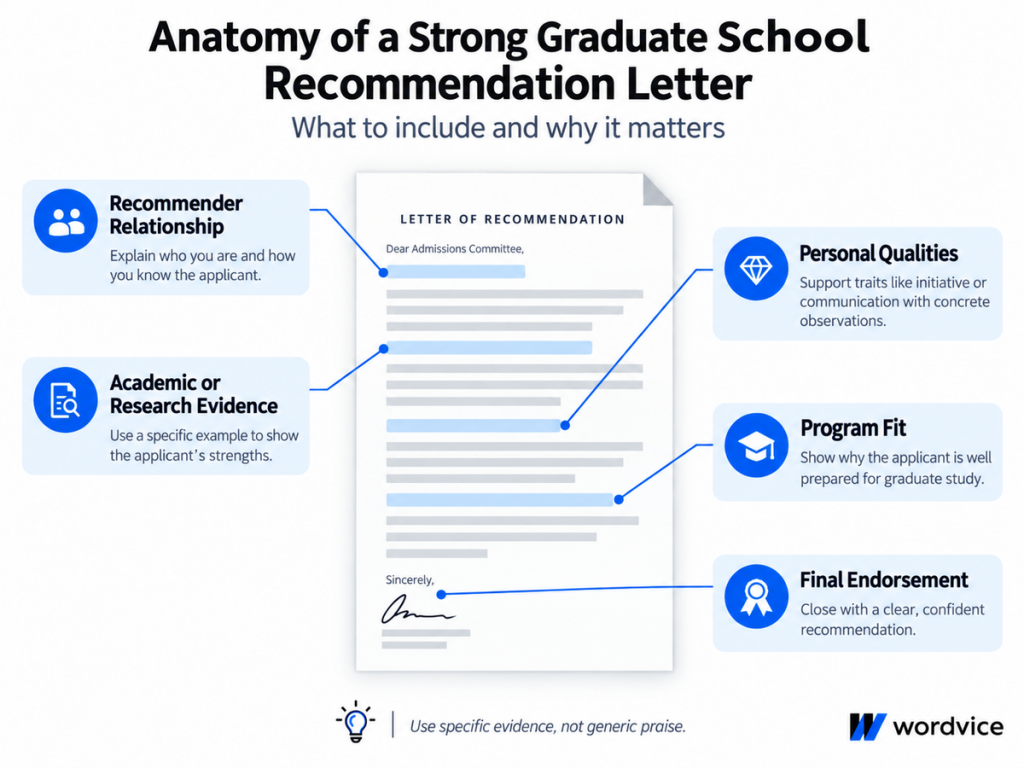
A well-structured recommendation letter will guide the reader logically towards an understanding of why this student is an excellent candidate for graduate school. It should focus on their achievements, their personal character, and their ability to thrive in a difficult academic environment.
Use this outline to organize the applicant’s achievements, skills, and traits. The number of paragraphs can vary, but it’s important that each one communicates something useful.
1. Greeting: Address the recipient by name
If you have the name of the recipient, address them directly. Otherwise, address the program’s admissions committee:
Dear [Recipient’s Name],
Dear Members of the [Program] Admissions Committee,
2. Opening paragraph: State your position and relationship to the applicant
Start with the following sentence:
It is my pleasure to recommend [Student] for admission to [Program] at [University].
Then, introduce yourself and state your relationship to the student and how long you have known them. In the sample above, the professor identifies the course that Jane was in and gives a general assessment of her work.
3. Academic or research strength: Provide a specific example with evidence
Choose a strength you have observed and show it by referencing the student’s work. The second paragraph in the sample above connects Jane’s analytical ability to her project and course performance.
Ask yourself: What did this student do specifically that impressed me? What did their work show that a grade alone would not?
4. Other strengths: Include additional examples and personal observations
Use the next paragraph or two to discuss additional qualities that add to the picture. In Jane’s case, the professor moves from research to classroom communication, then to perseverance and initiative. The details about the class discussions and office hours make those paragraphs more than just lists of adjectives.
Demonstrate through examples. Don’t just write that the applicant is persistent—show it!
5. Final paragraph: Discuss the applicant’s readiness for the program and give a clear recommendation
Explain how the qualities and examples you have described demonstrate that the student is prepared for the program. If you know the program’s requirements or focus, make specific connections. Avoid praising the university’s reputation. The important thing is to explain the applicant’s suitability.
For the above reasons, I am confident that [Student] will make an excellent addition to your graduate program, and I wholeheartedly support their application.
6. Closing line: Offer to be contacted
Close with a polite offer to provide further information. At the bottom, write your name, title, institution, and contact details, as required by the program.
If you have any questions about [Applicant] or this recommendation, please do not hesitate to contact me.
What Information Should a Graduate Recommendation Letter Include?
A letter of recommendation for graduate school should cover all of the applicant’s relevant skills, from their academic abilities and research experience to any applied experiences outside of the classroom. As the recommender, your letter should provide clear answers to these questions:
- What is your relationship with the student?
- Why should the graduate faculty listen to your opinion? Include your position and the work you have supervised or assessed.
- What makes this student special? Discuss their characteristics, qualities, and strengths.
- What did this student do specifically that impressed you? Discuss their accomplishments and habits in class.
- What makes this student qualified for graduate school and for this program? Include relevant coursework or interests alongside their abilities and traits.
- What do you know about the program the student is applying to? Try to link it directly to the student’s previous work.
What Style of Writing Should You Use?
A letter of recommendation should be more personal than a research paper, but still professional. Make sure the language is clear and free of grammatical errors. Apply the following principles as you draft:
- Use a more personal tone than in research writing.
- Use the active voice and first-person pronouns when describing your observations.
- Organize the letter around important strengths, then support them with illustrative examples and achievements.
- Include details such as course names, relevant scores, and specific achievements.
- Edit your letter before submitting it.
Useful phrases for recommendation letters
Common expressions can be especially useful if English is a second language. Use the following phrases to get started, then add details to make the letter your own.
Introducing yourself and your relationship with the applicant
- My name is [Recommender], and I have been a professor of [Subject] at [University] since [Date].
- I first came to know [Student] while teaching [him or her] in my [Course] course.
- I was [Student]’s thesis advisor during [his or her] senior year.
- I have known [Student] for several years now and can attest to [his or her] strengths and quality of character.
Discussing the student’s strengths and supporting evidence
- [Student] has excellent communication skills and displays them regularly in class discussions.
- Not only is [Student] hardworking and thoughtful, but [he or she] also demonstrates kindness and generosity towards other students.
- [Student] demonstrated their independence by completing difficult lab exercises and performing research outside of class.
- During [his or her] internship, [Student] managed [his or her] work responsibilities consistently and diligently and learned new tasks quickly. For example, [Specific Details].
Discussing the program and making a final endorsement
- [Student]’s work in [Course or Project] has prepared them for [Specific Aspect of the Program].
- For the above reasons, I am confident that [Student] will make an excellent addition to your graduate program, and I wholeheartedly support their application.
Who to Ask for a Recommendation Letter for Graduate School?
Choosing which professors, supervisors, or advisors to request a graduate school recommendation letter from can be overwhelming. Should you choose someone who does not know you personally but who has connections to your target graduate school? If a famous professor writes you a graduate school recommendation letter, will this give you an advantage with the admissions committee?
In general, graduate recommendation letters should come from people who know you well and can speak positively and in detail about your work. A past or current professor or academic advisor is often a great choice, but first check the program’s requirements for academic and professional references.
You could also choose someone with a slightly different role, such as an employer, a senior colleague, or a professor from a different department or kind of class (e.g., a discussion class instead of a lecture). Whoever it is, they should know you well and recognize your accomplishments. It also helps if they know some details about the program you are applying to.
When choosing who to ask for a letter of recommendation for graduate school, consider people who:
- Know you well and will write a positive recommendation. Choose someone who has had opportunities to observe your work closely, whether in or outside the classroom. They should also be familiar with your career goals and have a favorable opinion of you.
- Have known you for quite a while. If you can, find someone who knows you in multiple contexts, such as a professor who was also your advisor. The goal is to find someone with enough experience of your work to share meaningful observations.
- Can speak to your strengths in relation to the graduate program you are applying to. A finance professor who knows your work well may be a useful recommender for an MBA program because they can discuss qualities relevant to that field and a broader career in business—qualities you may also discuss in your MBA essay.
- Have substantive stories to share about you. Who was fortunate enough to see you succeed in an academic, extracurricular, or professional setting? Getting a LOR from someone who has good stories to share about you is likely to be more helpful than from someone who knows you only as one of two hundred students in a lecture hall.
How to Request a Letter of Recommendation for Graduate School
Knowing how to request a letter of recommendation can help your recommender prepare a thoughtful letter. Make sure to be respectful and show consideration for the time they are taking to support your application.
If you see the person regularly, you can ask them directly. If you no longer study or work together, email is fine. Explain which programs you are applying to, give them the deadlines, and ask if they would feel comfortable writing a strong recommendation for you.
Remember to always be cordial and polite when making this request, and give the person room to decline if they do not have the time or do not feel they know your work well enough.
What Information Does the LOR Recommender Need from Me?
Make sure to give the recommender sufficient time to write the letter. If you haven’t talked to them in a while, it’s a good idea to send them some background information about yourself. The following details and reference documents will make things a lot easier for them:
- Classes you have taken with the recommender
- Experiences you have shared
- Transcripts
- Resume/CV
- Research experience and internships
- Awards and achievements
- Academic/career goals
- Relevant professional experience
Also make sure that the recommender has the information they need to complete the letter on time and target it to the specific school. This includes:
- Application due date
- Recommendation questions or forms, if provided
- Instructions for submitting the recommendation letter
- Details about the program and school
If you are applying to multiple schools, a simple list of programs, deadlines, and submission instructions can save your recommender a lot of time. You can share factual notes and reminders, but let the recommender decide how to assess and describe your work.
The Final Step: Editing Your Recommendation Letter
As every writer knows, a strong and compelling piece of writing takes more than one draft. Once you have written your recommendation letter, there is still room for revision.
Read it once for the argument. Have you shown clearly why this student is ready for graduate study? Then read it again for the details. Double-check the student’s name, the program, your relationship, and the examples you have chosen. Make sure every statement is accurate and that the letter follows the specific instructions of the program.
If the program permits outside language editing, you can use Wordvice’s recommendation letter editing services to check grammar, tone, and clarity. The assessment and final letter should remain the recommender’s own, and any editing arrangement should respect the program’s confidentiality requirements.